
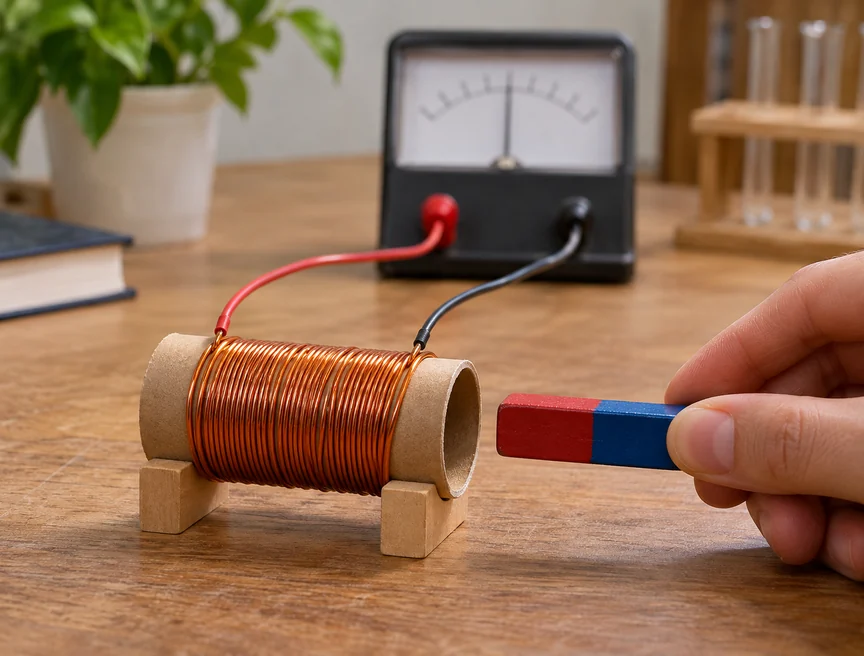
Yes, if you change the magnetic field passing through a coil of wire. Move a magnet toward the coil and a voltage appears across the ends of the wire. Hold the magnet still and the voltage goes away. A refrigerator magnet gets to spend its entire career doing the easy part.
Digging deeper
Picture a coil connected to a meter. Push the magnet toward the coil and the needle kicks one way. Pull it back and the needle kicks the other way. Each motion changes the field through the coil in the opposite direction, so the voltage reverses. This is called electromagnetic induction.
Close the circuit and that voltage can drive current. When current flows, it creates a magnetic effect that resists the motion you’re making. You supply the energy by doing the work of moving the magnet. The magnet helps turn some of that motion into electrical energy.
Where does the power plant come in?
A generator uses the same idea. A turbine keeps a magnetic field moving relative to coils of wire. As the field moves around, the voltage in the coils repeatedly changes direction. That’s how a lot of the alternating current on the grid gets started.
For more on how a generator makes electricity and gets it to the grid, see Basics of Electric Utilities 101.