
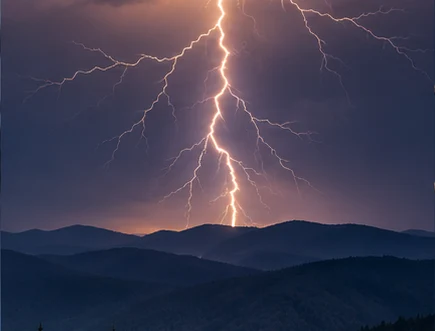
Say a lightning flash releases 5 billion joules. That’s about 1,400 kilowatt-hours, enough to run some homes for a month if you could recover it all or send a time traveling DeLorean back to 1985. Unfortunately there are a number of big problems with practically putting this energy on the grid the greatest of which is the insignificant amount of energy actually available compared to the large cost to capture it.
Even if you decided to focus on key lightning areas, imagine how many Eiffel Tower-sized collectors you’d need to catch a useful number of strikes. A system would need to handle brief, unpredictable surges, store the energy, and deliver it to the grid.
Some of the energy in a strike goes into heat and light. The air around a lightning channel can reach about 50,000°F, producing a shock wave known as thunder. You’d also lose energy in conversion, storage, and delivery.
On the bright side there are much easier ways of harnessing natural energy. For example, about an hour of sunlight reaching Earth carries roughly as much energy as the world uses in a year. Working out the solar energy challenges seems to be a more efficient use of time.
For more on electrical energy and how utilities generate and deliver power, see Basics of Electric Utilities 101.