
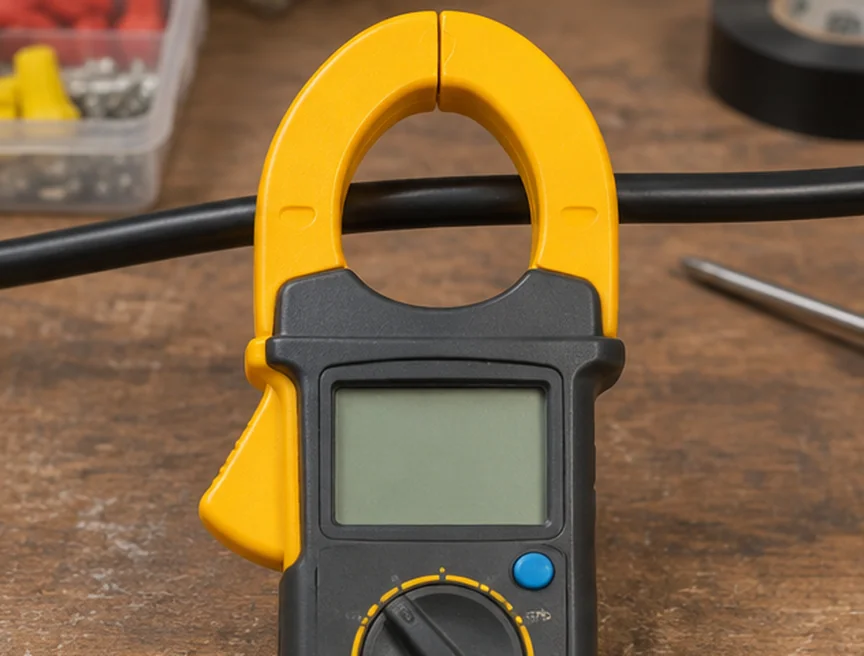
You’ve probably seen a meter with jaws that open like a claw. Close those jaws around one insulated wire and the meter can tell you how much current is flowing. Current makes a magnetic field around the wire, and the clamp can pick up that field through the insulation.
How does it turn a magnetic field into a number?
An AC clamp can work like a transformer. The wire through the jaws acts like one turn of a coil, and the changing field induces a signal in a coil inside the meter. A meter that can read DC often uses a Hall-effect sensor, which can pick up a steady magnetic field too.
Why does it usually go around one wire?
If the jaws go around both the outgoing and returning wires in a cord, the currents usually flow in opposite directions and their fields cancel. The meter reads the difference between them, which can be close to zero even when the appliance is running.
For more on current and magnetic fields, see Basics of Electric Utilities 101.