
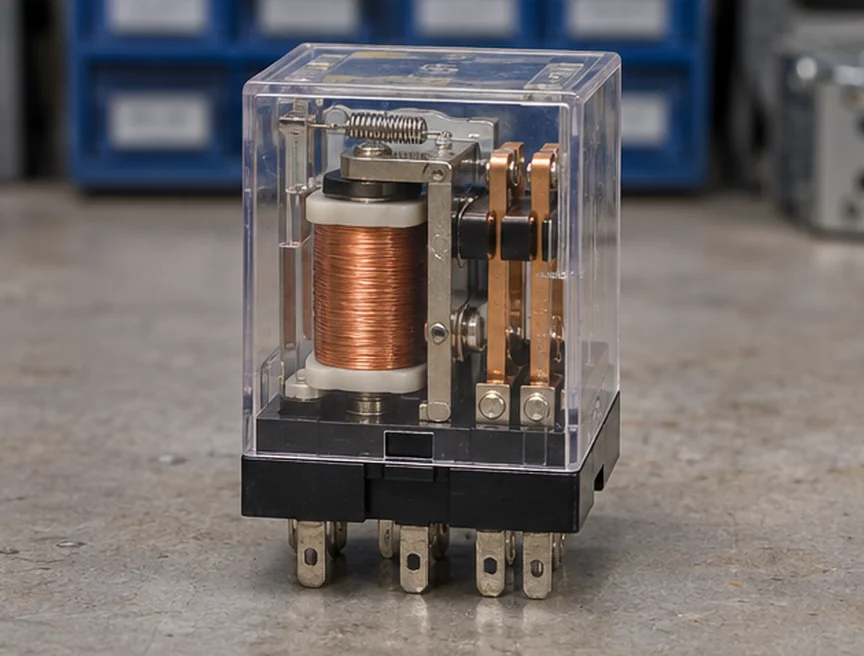
An ordinary electromechanical relay has a coil and a set of contacts. A little current through the coil makes a magnetic field. The field pulls on a moving metal piece that opens or closes the contacts. A different circuit can supply the load through those contacts.
Why bother with a second circuit?
The control may be far away from the load or work at a lower voltage. A thermostat, for example, can send a small signal to equipment with a motor. The contacts do the switching at the equipment, while the control only needs to drive the relay.
Does every relay make a click?
The click comes from moving parts. A solid-state relay can do a similar switching job with electronics. It has its own limits on voltage, current, and how much heat it can handle.
For more on how current and magnetism operate electrical switches, see Basics of Electric Utilities 101.