
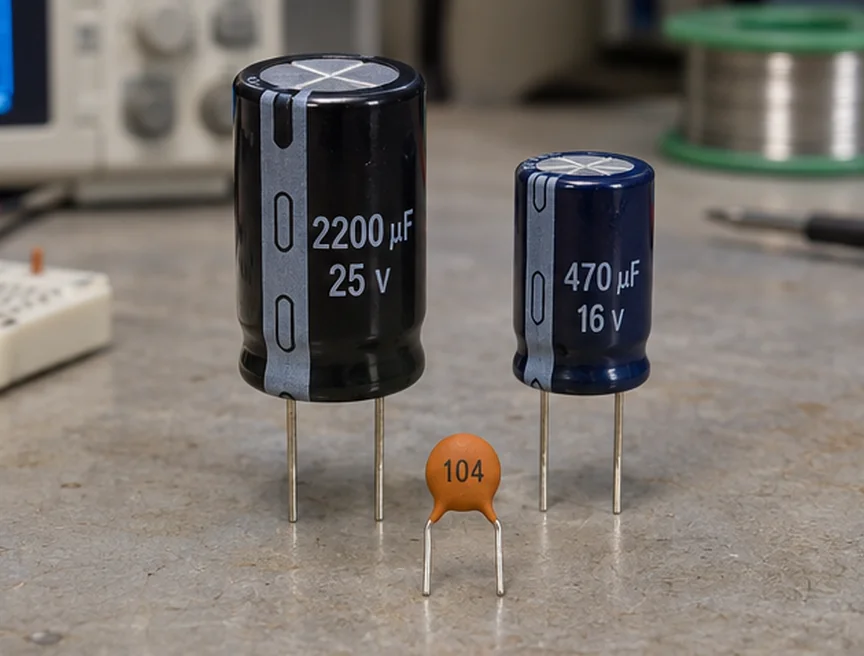
A capacitor has two conducting surfaces separated by an insulating material. Connect it to a voltage and charge builds up on the two surfaces with opposite signs. There’s an electric field in the space between them. That field holds energy that the capacitor can give back later.
Why can it take or give back energy quickly?
Charge can move onto or off the surfaces as soon as there’s a path through the rest of the circuit. That can happen very quickly. A small capacitor can help smooth out a voltage that’s changing faster than a power supply can correct by itself.
Why do capacitors come in so many sizes?
A capacitor’s value depends on factors like the area of the surfaces, the space between them, and the insulating material. The voltage it can handle matters too. Different jobs call for different combinations.
For more on capacitance, voltage, and electric fields, see Basics of Electric Utilities 101.