
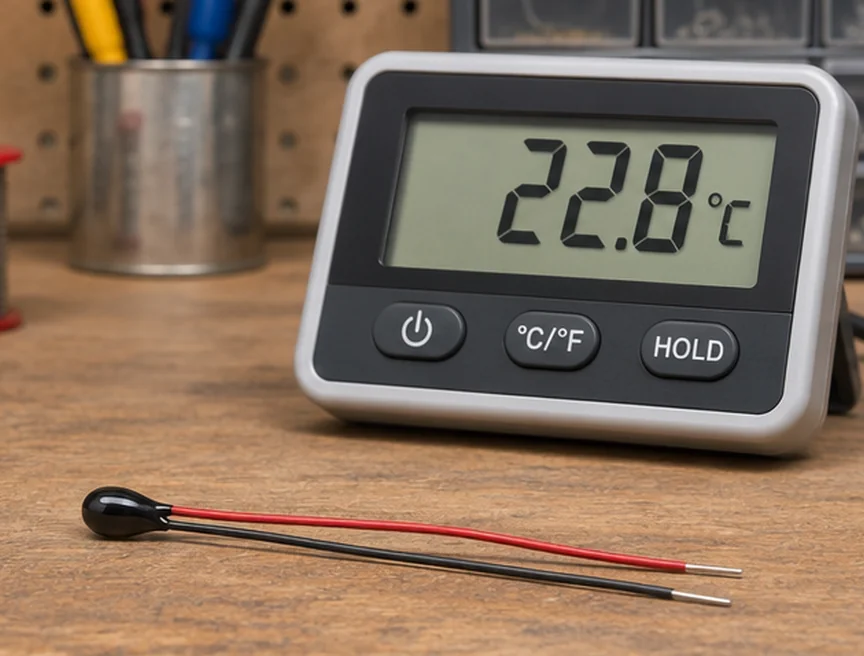
Many digital thermometers use a tiny part called a thermistor. Its electrical resistance changes as its temperature changes. The thermometer measures that resistance or the voltage it produces in a small circuit, then uses a known relationship to turn the reading into a temperature.
Why does it take a moment to settle?
The sensor itself has to warm up or cool down to match what it’s measuring. Its metal tip, coating, and surroundings can slow that change. A thin sensor in moving air can respond differently from a thick one against a solid surface.
Does every electric temperature sensor work that way?
Other designs can use a semiconductor or a pair of metals that produce a small voltage when their ends are at different temperatures. The choice depends on the range, speed, and accuracy the job needs.
For more on how resistance can be used to measure something, see Basics of Electric Utilities 101.