
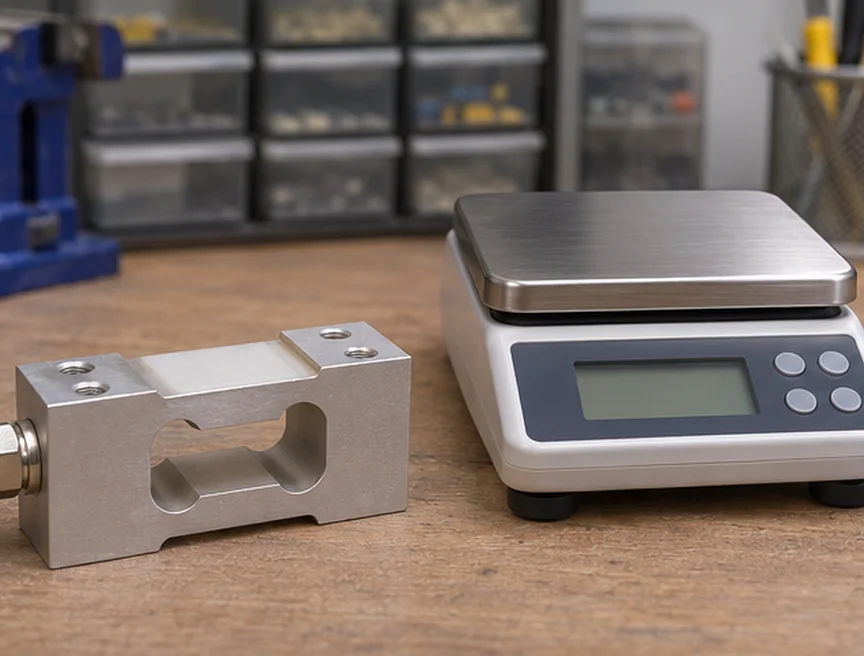
Many electronic scales have a metal part that bends a tiny amount under a load. Small resistive strips called strain gauges are attached to it. As the metal bends, the strips stretch or compress. That changes their resistance slightly.
How does the scale see such a small change?
Several gauges can be connected so one change adds to another in the circuit’s output. An amplifier makes that small voltage easier to measure. A calibration tells the scale what load corresponds to the measured change.
Why does the scale have a zero button?
A container may already be pressing on the scale. Zeroing tells it to treat that starting load as the reference for the display. The load cell still feels the container and whatever you add. The scale just subtracts the starting reading.
For more on resistance and how electrical signals carry measurements, see Basics of Electric Utilities 101.