
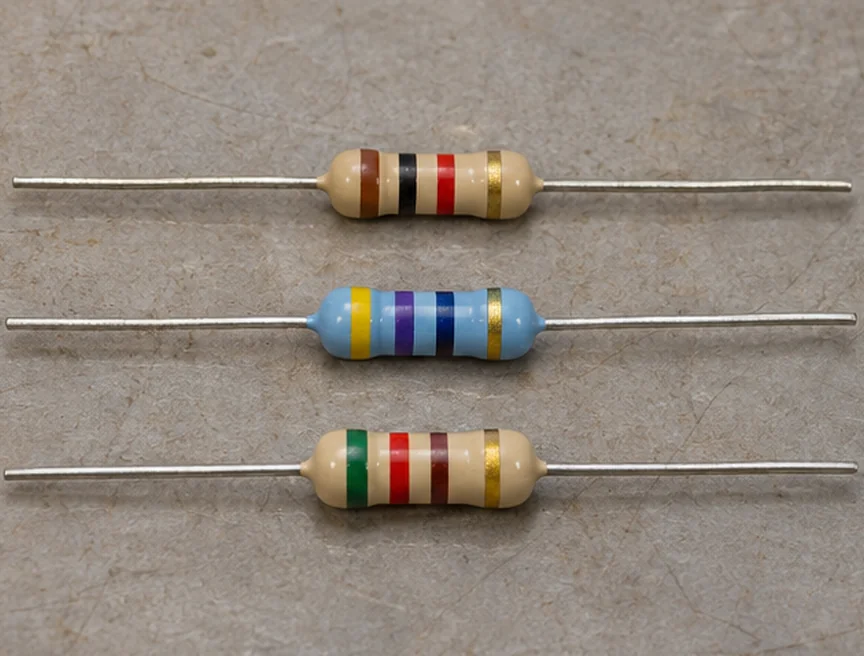
A small resistor may have room for a few stripes even when there’s little room to print numbers. The colors give its resistance in ohms. In a common four-band code, two bands give digits, another tells you what to multiply them by, and the last gives the tolerance.
What does tolerance tell you?
A resistor marked 100 ohms with a five-percent tolerance can be a little above or below 100 ohms and still meet its rating. In many circuits that difference is fine. Where the exact value matters more, the design can use a tighter tolerance.
Does every resistor have stripes?
Some small resistors use a printed code instead. Others are too small for much marking at all. The band code is especially common on the kind with a wire lead out of each end.
For more on resistance and why it matters in a circuit, see Basics of Electric Utilities 101.