
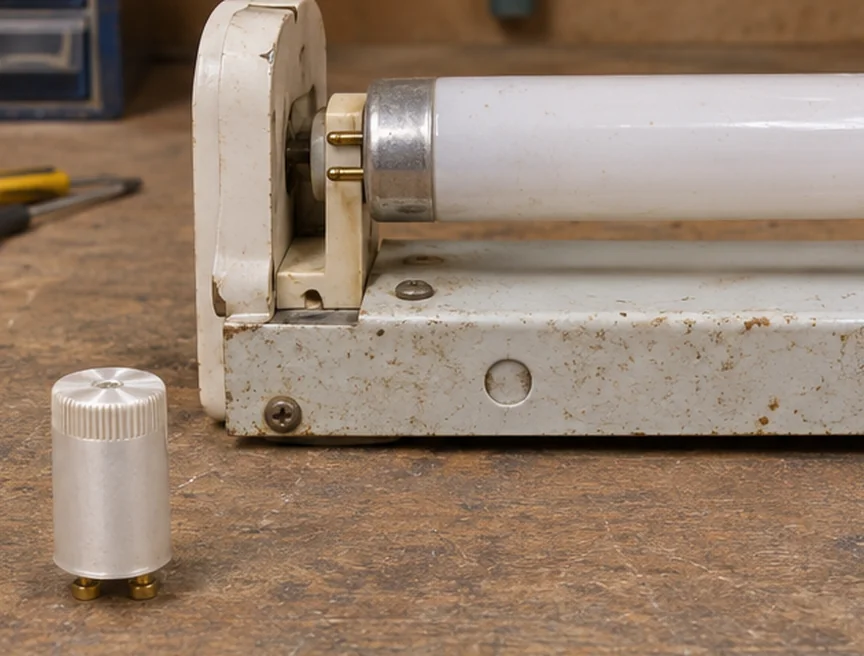
Some older fluorescent fixtures have a small starter that helps the tube light. A glow starter briefly closes contacts so current can warm electrodes at the ends of the tube. Then the contacts open. The change in current through the ballast helps produce a voltage pulse across the tube.
Why does the light sometimes blink several times?
The tube may fail to light on the first try, especially if it’s cold or worn. The starter can repeat the sequence. After the tube lights properly, its operating voltage is normally too low to make the starter repeat it.
Does every fluorescent light have a starter can?
Other fixtures use a ballast that handles starting in a different way. Electronic designs can do it without a separate little can. The parts belong to a particular kind of fixture and tube.
For more on how electrical circuits get lamps started, see Basics of Electric Utilities 101.