
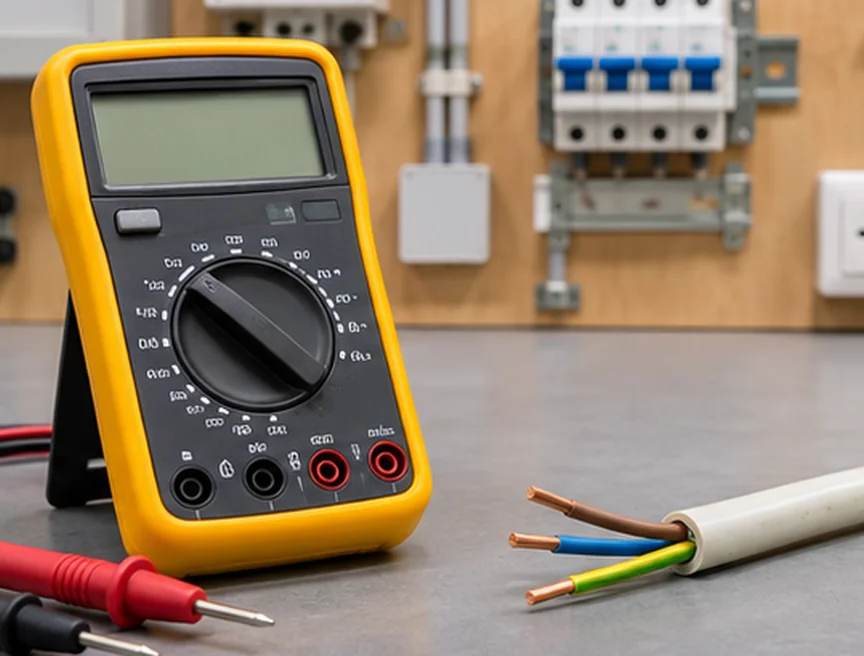
A disconnected wire can run alongside a wire that carries AC. The small gap between them acts a little like a capacitor. As the energized wire’s voltage changes, it can pass a tiny amount of current to the other wire. A sensitive meter can show a voltage even though the wire has no direct connection to the source.
Why can a meter see it?
A typical digital meter in voltage mode takes very little current. It can show a reading from that weak coupling. A measurement that draws more current will often make the reading collapse, because the coupling can’t supply much current.
Can you assume an unexpected reading is a ghost?
No. A real supply can also produce an unexpected reading. A qualified person has to determine where the voltage comes from before treating the circuit as de-energized.
For more on voltage and how nearby conductors interact, see Basics of Electric Utilities 101.