
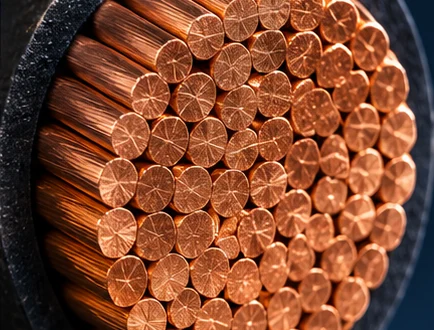
In a uniform wire carrying steady direct current, current is distributed across the cross-section. Alternating current tends to concentrate near the surface. Skin depth is the distance below the surface at which the current density in a thick conductor falls to about 37% of its surface value. At 60 Hz, skin depth is roughly 8.4 mm in copper and 11 mm in aluminum, depending on conductivity. Current density continues to decrease deeper in the conductor. The effect becomes more noticeable as the conductor diameter increases relative to the skin depth.
What causes Skin Effect?
Alternating current creates a changing magnetic field. It induces currents that oppose the change more strongly in the interior, so more current flows near the surface.
Would you rather walk up a stream along the banks or in the middle? My 3 young boys would rather walk up the stream in the middle but they are not normal electrons.
How does frequency change the skin effect?
Higher frequency makes the skin depth smaller, concentrating current closer to the surface and increasing the conductor’s AC resistance. Skin depth also depends on the material’s electrical conductivity and magnetic permeability.
Transmission Engineers hate him, find out why…
Skin effect losses become more apparent in transmission lines due to the conductor’s size and weight. You have to make the wire bigger and bigger to get ever diminishing amounts of current carrying capacity. Sure, increasing the wire size slightly increases the useful current carrying surface area near the circumference but it also significantly (quadratically) increases the cross sectional area which in turn drastically increases weight and cost. A lot of cost for diminishing benefits is the law of diminishing returns. Some large underground cables use insulated conductor segments to reduce AC resistance. Overhead bundles are also used to lower the electric field at each conductor and reduce corona. Why have a middle at all? Some applications just use tubes like in switchyards or flat bus bars.
Last fact… you might think that since each actual conductor has multiple strands of interwoven wires each would have their own skin effect. However they touch so much that they act similar to a single solid core in terms of skin effect. Many high-voltage lines use an aluminum cable with a steel core in the middle of the interwoven wires to reinforce it called ACSR. The aluminum carries most of the current while the steel adds tensile strength.
This is such a deep topic, 8.4mm deep! * I’ll see myself out *
For more on AC and DC and how utilities move electricity, see Basics of Electric Utilities 101.