
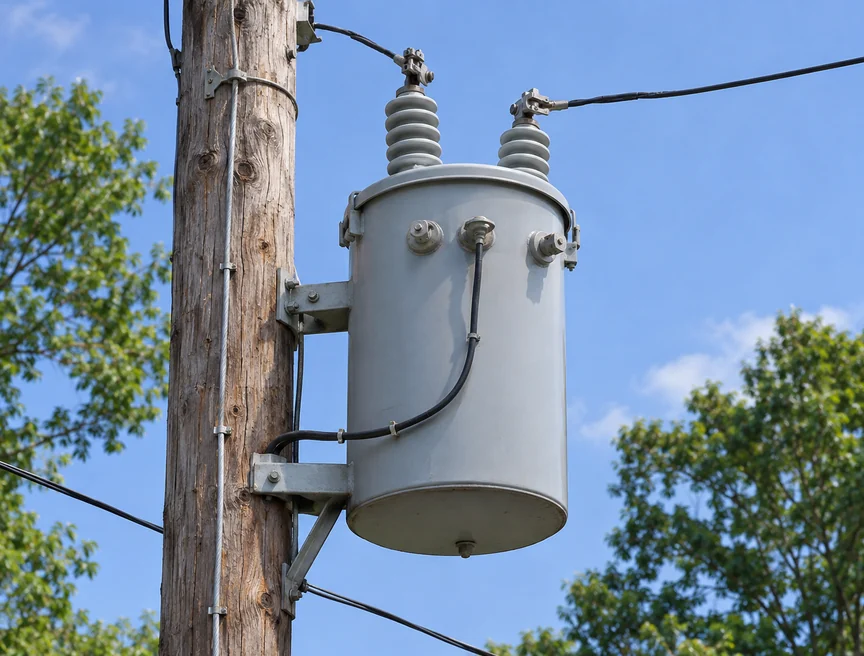
That gray can is usually a distribution transformer. It takes the higher voltage on the neighborhood line and steps it down to the voltage your house can use. In a typical U.S. house, that means 120 volts for ordinary outlets and 240 volts for bigger loads such as an electric dryer.
What’s inside the can?
Two coils of wire share a metal core. Alternating current in the first coil creates a changing magnetic field in the core. That changing field induces a voltage in the second coil. Give the second coil fewer turns and you get a lower voltage. You can think of it as gears on a bike, trading one thing for another. Here the trade is voltage for current.
The can often contains insulating oil. It helps keep the electrical parts insulated and carries heat from the coils to the outside of the tank. Turns out the can is doing more work than it gets credit for.
What if my neighborhood has no poles?
If your lines run underground, look for a green box on a concrete pad. Some of those boxes do the same job. Same idea, different outfit.
To see how utilities size, cool, and protect this equipment, explore Power Transformer Fundamentals.