
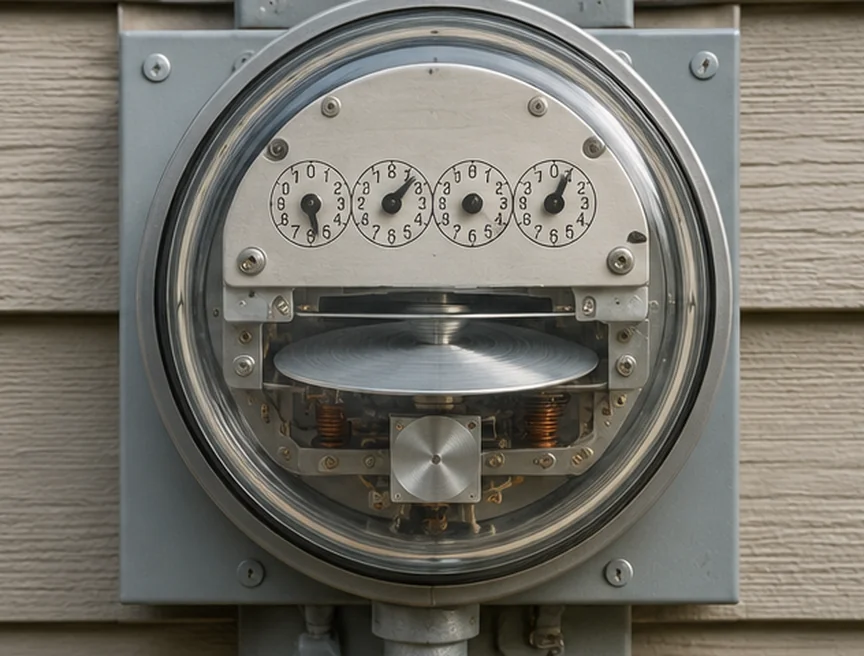
Look through the glass on an older electric meter and you might see a thin metal disk turning. Turn on the oven and it spins faster. Turn most things off and it slows down. That disk is doing the same job as a digital meter. It’s adding up how much energy you use.
What pushes the disk?
Two coils create magnetic fields. One responds to the voltage and the other responds to the current your house draws. Together their fields induce little currents in the aluminum disk and make it turn. A permanent magnet acts as a brake, so the disk settles at a speed that tracks the power you’re using.
How does that become a bill?
Each turn represents a certain amount of energy. Gears count the turns and move the dials you can read through the glass. The speed is power, and the turns added up over time are energy.
For more on watts and kilowatt-hours, see Basics of Electric Utilities 101.