
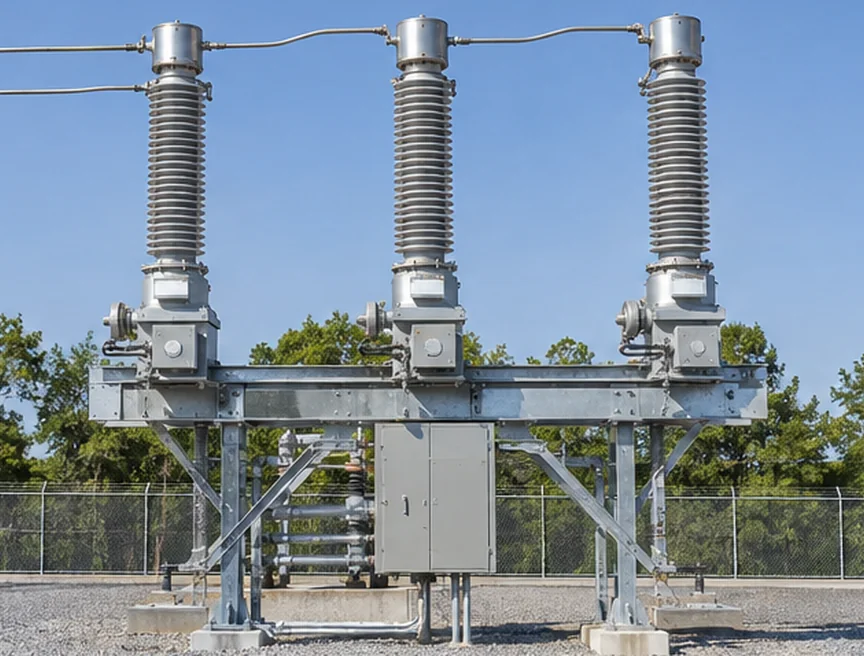
A breaker in your house and one in a substation both have to stop current when something goes wrong. The substation breaker may have to interrupt much more current at a much higher voltage. That makes the electrical arc that forms as its contacts open much harder to put out.
What happens to the arc?
The breaker has an interrupter built to control the arc until the current stops. Then the gap needs to withstand the voltage coming back across it. Different breakers do that with vacuum, insulating gas, or other designs suited to their voltage and duty.
Why all the room around it?
The live parts have to stay well separated from the ground and the other phases. The tall insulating columns and the open space are part of how the equipment keeps electricity on the path it belongs on.
For more on how utilities switch and protect high-voltage circuits, see Substation Systems.