
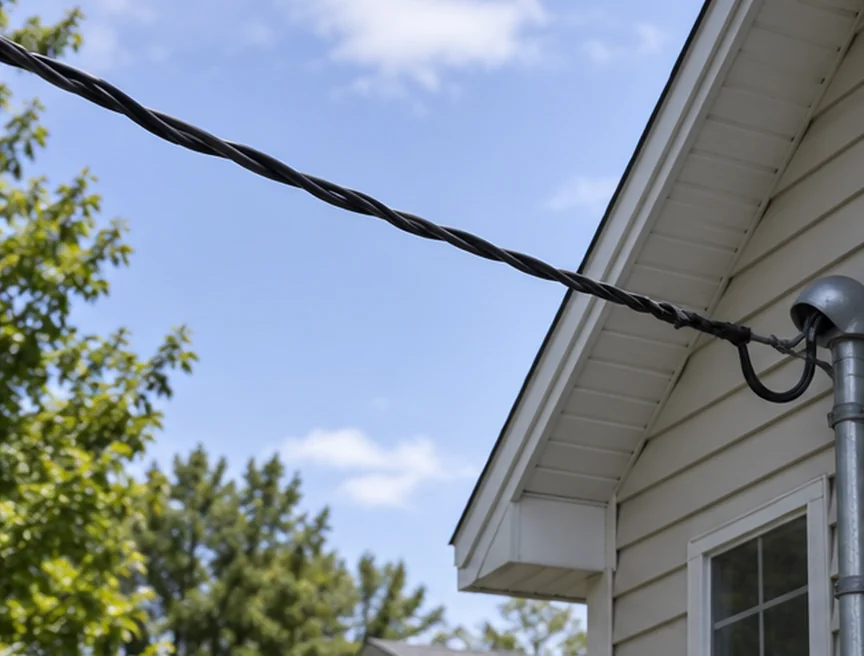
The last stretch of overhead wire from the pole to a house is called a service drop. A typical U.S. house has two insulated hot conductors and a neutral. You’ll often see those three wrapped together as one cable instead of strung separately.
What holds the bundle up?
In a common triplex service drop, the neutral also acts as the messenger. That’s the conductor designed to carry the mechanical load between the attachment points. The other two wires are wrapped around it, so the three can be hung as one assembly. Other utilities may use a design with a different support arrangement.
Why keep the wires together?
The bundle takes up less room and is simpler to install across a yard. The wires move together in the wind instead of each hanging on its own. The two hots can still supply 240 volts between them, or 120 volts from either one to neutral in a typical house.
For more on how utility power reaches your home, see Basics of Electric Utilities 101.