
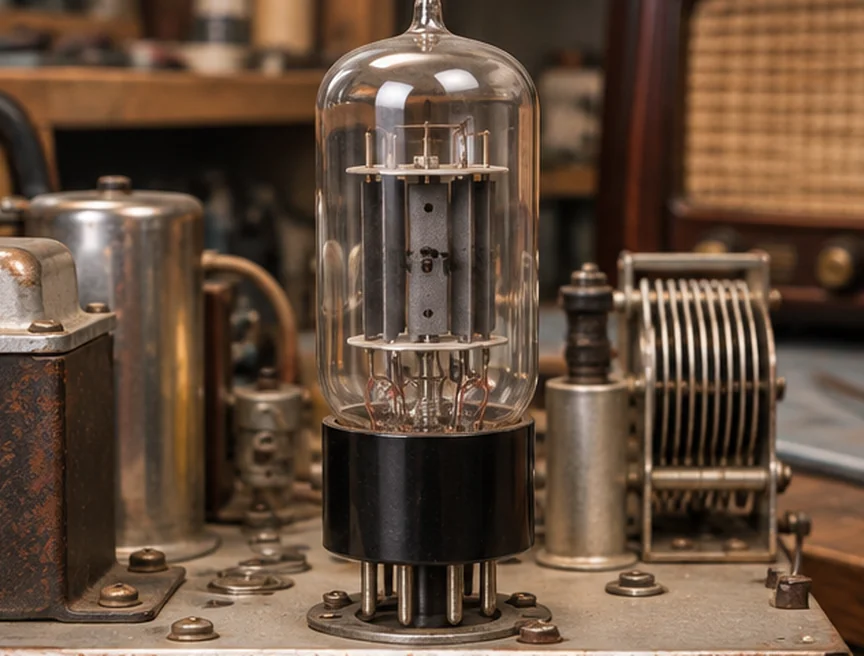
Turn on an old tube radio and you may hear nothing for a few seconds. Inside, a little heater is warming a metal part called the cathode. Once the cathode gets hot enough, electrons can escape from its surface.
What does that have to do with sound?
A positively charged plate inside the tube attracts those electrons. A little grid between the plate and cathode acts like a gate. A small change in the voltage on the grid can control a much larger change in current through the tube. That’s how the radio can make a weak signal strong enough to play through a speaker.
Why does a newer radio start so fast?
A transistor can control current without heating up a cathode first. That lets the amplifier start working almost as soon as it gets power. Any delay you hear on a digital radio is usually the electronics getting started.
For more on electrons and electric current, see Basics of Electric Utilities 101.