
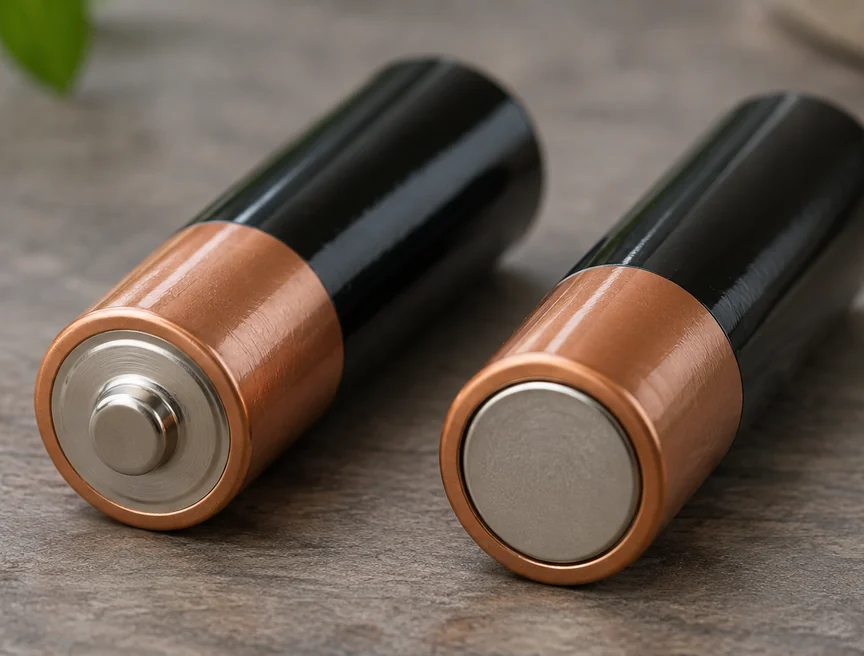
A battery’s chemistry gives its two ends different voltages. The positive end is at a higher voltage than the negative end. Put the battery in a flashlight and close the switch, and that difference can drive current around the circuit.
What’s going on inside?
Inside the battery are two electrodes and a material between them called an electrolyte. While the battery is working, chemical reactions release electrons at the negative electrode and take them up at the positive electrode. The electrons travel through the flashlight circuit. Inside the battery, charged particles called ions move through the electrolyte to keep things in balance.
Why does one battery go in upside down?
In many devices, the batteries sit side by side with one flipped around. Look at the plus and minus signs molded into the battery compartment. The contacts can still connect the plus of one battery to the minus of the next. Two 1.5-volt batteries connected that way give you about 3 volts.
Put one of those two batteries in backward and their voltages oppose each other. The flashlight can sit there looking perfectly assembled while the batteries effectively pull in opposite directions.
For more on voltage, current, and direct current circuits, see Basics of Electric Utilities 101.