
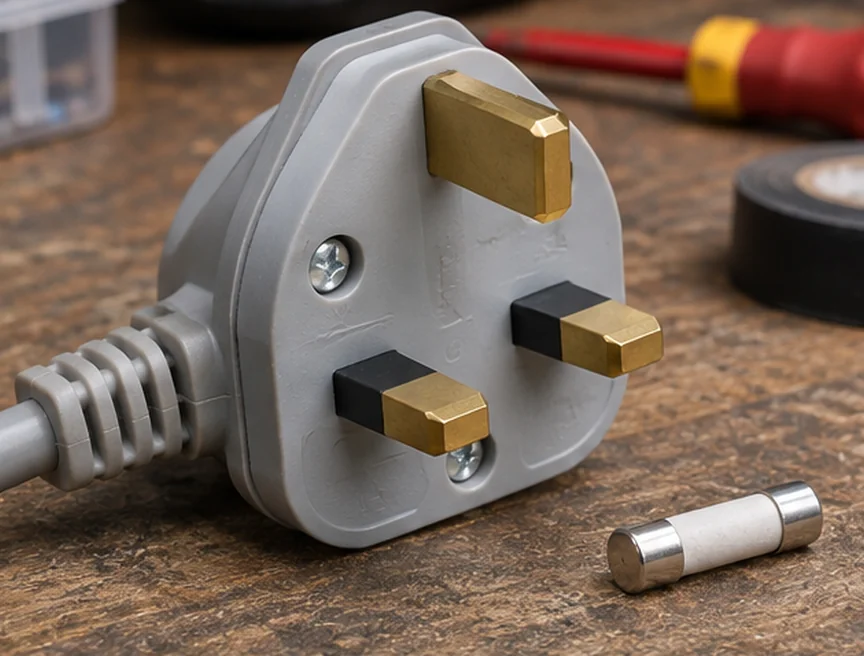
A typical British plug has a small fuse inside. Its main job is to protect the flexible cord between the plug and the appliance. If too much current flows for long enough, the fuse element heats up and melts, opening the circuit.
Doesn’t the breaker in the house already do that?
It protects the fixed wiring, but the two parts can be rated for different currents. A British ring circuit can supply several outlets and is commonly protected at 32 amps. The cord to a little lamp might carry only a fraction of that in normal use. A lower-rated fuse in the plug gives the cord protection appropriate to its size.
Do they all have the same fuse?
No. A small appliance often calls for a 3-amp fuse and a higher-power appliance may use a 13-amp fuse. The cord and appliance rating determine what belongs there.
For more on current and circuit protection, see Basics of Electric Utilities 101.