
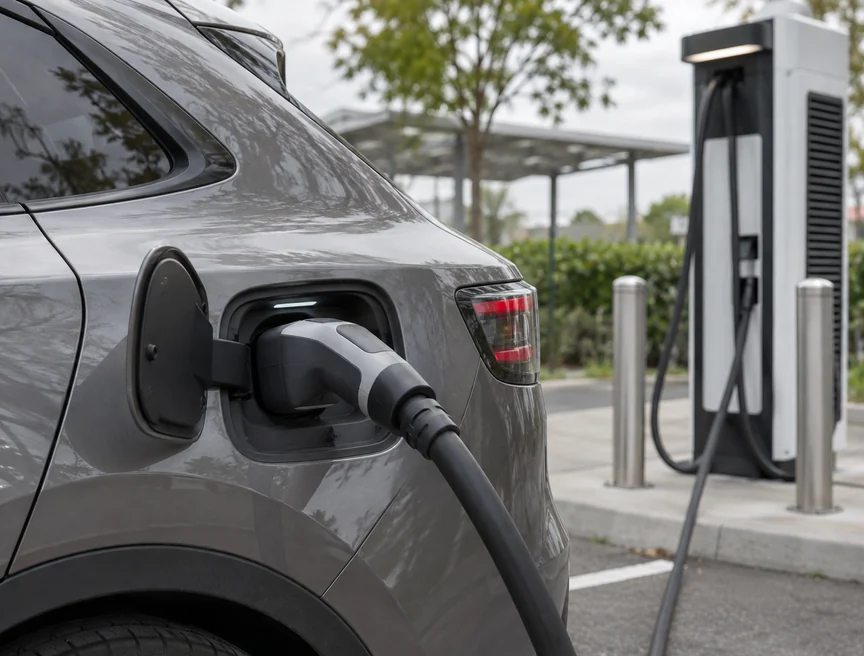
The car asks the charger to slow down as the battery fills. A nearly full battery can take only so much current before its cells approach their voltage limits. The car’s battery management system keeps an eye on those limits and reduces the charging rate as needed.
Think of filling a glass
You can pour quickly when the glass is empty. As the water gets close to the rim, you ease up so you don’t spill. The battery has a voltage limit instead of a rim. With many lithium-ion batteries, the charger first supplies a higher current. As the cells approach their target voltage, the system keeps the voltage in range and lets the current taper off.
What about the number on the charger?
A sign that says 150 kW tells you what the station can supply under the right conditions. The car may ask for much less, especially when its battery is nearly full, too cold, or too hot. Many cars slow down noticeably around 80% at a fast charger, but the exact point varies.
That’s why the first part of a charging stop can fly by while the last few percent feel like watching the microwave count down.
For more on batteries, charging speeds, and what affects charging demand, see Electric Vehicle Fundamentals.