
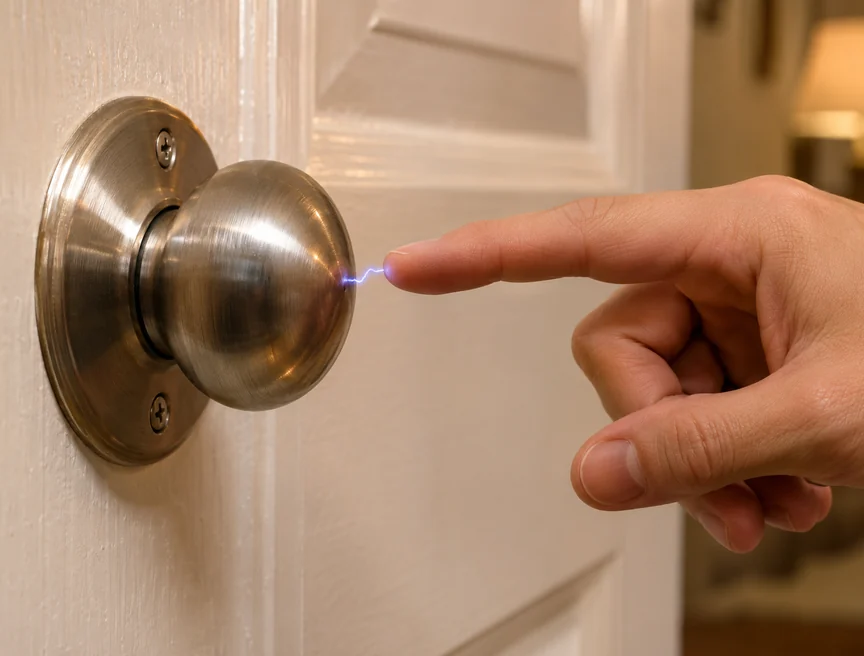
Walk across a carpet in socks, reach for a metal doorknob, and zap. Your socks and the carpet have been trading electrons. That leaves you with a little extra or a little less charge than you started with. The doorknob is where you find out about it.
What makes the spark?
As your finger gets close, there can be a big voltage difference across a tiny air gap. Air usually acts like an insulator. In a strong enough electric field, it can briefly conduct, and some charge jumps across the gap. That little rush of current is what you feel. Sometimes you can even see the spark in a dark room.
Why does it happen more in winter?
Dry indoor air helps charge stick around. When the air is more humid, a thin layer of moisture on many surfaces gives charge a way to leak away before you get to the doorknob. Add dry air, a carpet, and the right socks and you’ve got a nice little science experiment in the hallway.
A big voltage can go with a very small amount of stored energy. That’s why the entire show is over before you’ve finished saying “ow.”
For more on the difference between voltage, current, and energy, see Basics of Electric Utilities 101.