
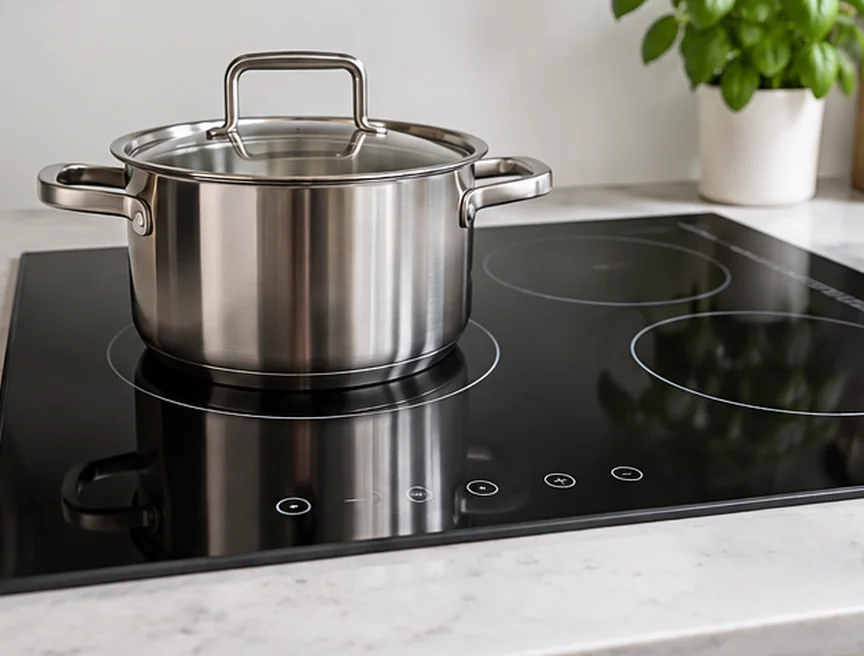
An induction stove has a coil under the glass. The current in that coil changes direction rapidly, making a changing magnetic field. Put the right pan over it and the field induces little loops of current in the bottom of the pan. The metal’s resistance turns that current into heat.
Why doesn’t every metal pan work?
Most household induction stoves are designed for a pan with a magnetic base. Cast iron usually works. Some stainless steel pans work and others don’t. An aluminum pan can work too if its bottom has a layer of the right steel. If a magnet sticks firmly to the bottom, that’s a good first check.
Does the glass get hot too?
The stove heats the pan directly. The hot pan can then heat the glass underneath it. That’s why the surface can still be hot after you lift the pan away.
For more on electric current and magnetic fields, see Basics of Electric Utilities 101.