
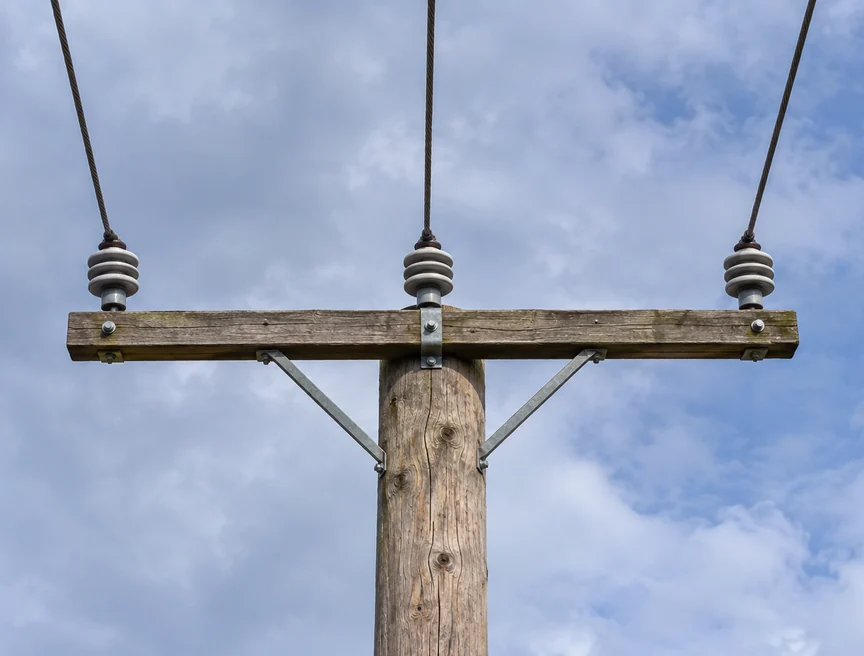
Those three wires often carry three-phase power. Each phase has an alternating voltage that rises and falls. The three waves are spaced a third of a cycle apart, so each reaches its peak at a different time.
Picture three people on a merry-go-round
Put them evenly around the edge and pick a spot by the railing. Each person passes that spot once per turn, with the same amount of time between them. The voltages do something similar. On a 60-hertz system each one completes 60 cycles a second, and each peak follows the previous phase’s peak by a third of a cycle.
Why go to all that trouble?
The timing makes it easy to create a rotating magnetic field in a motor. With a balanced three-phase load, the total power delivered is also steady over the cycle. That’s helpful for big pumps, fans, and other equipment that like a smooth push.
Many homes only need single-phase service. A neighborhood line can carry all three phases past your street while the transformer serving your house is connected to just one of them.
For more on single-phase and three-phase power, see Basics of Electric Utilities 101.