
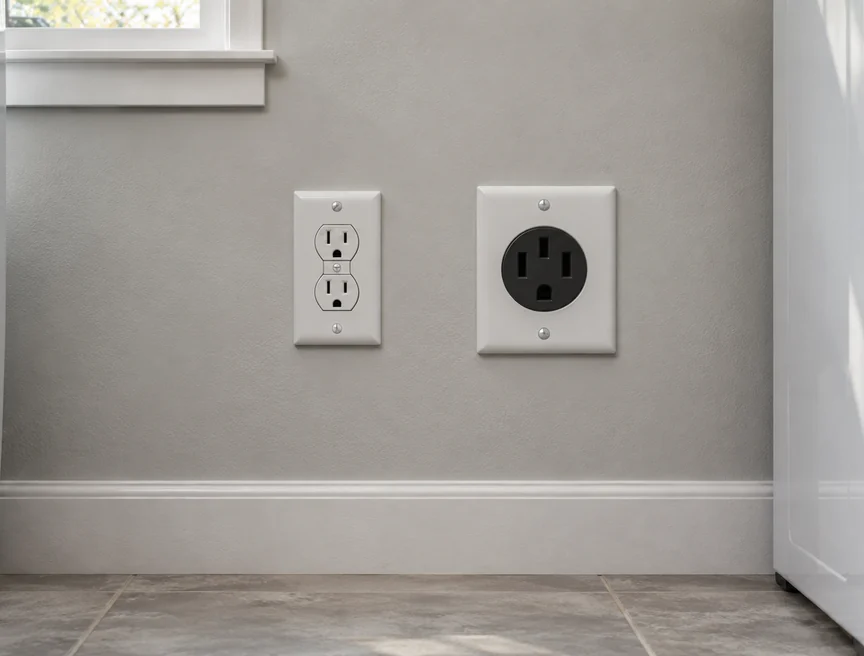
In a typical U.S. house, the same electrical service gives you both. An ordinary outlet uses one hot wire and a neutral for 120 volts. A dryer or range can use both hot wires and get 240 volts between them.
Where did the extra 120 volts come from?
Picture a ruler with zero in the middle. One end is 120 units to the left and the other is 120 units to the right. Each end is 120 units from the middle, and the ends are 240 units apart. The house transformer has a connection at the midpoint of one winding. That midpoint is the neutral. In AC the two ends trade sides every half cycle, but the voltage between the ends still has twice the magnitude of either one to neutral.
Why does the dryer want more?
Big heaters, such as the one in an electric dryer, need a lot of power. A 4,800-watt heater takes about 20 amps at 240 volts. A heater built for the same power at 120 volts would take about 40 amps. The higher voltage lets the appliance do the same job with less current.
For more on volts, amps, and how utilities get electricity to your house, see Basics of Electric Utilities 101.