
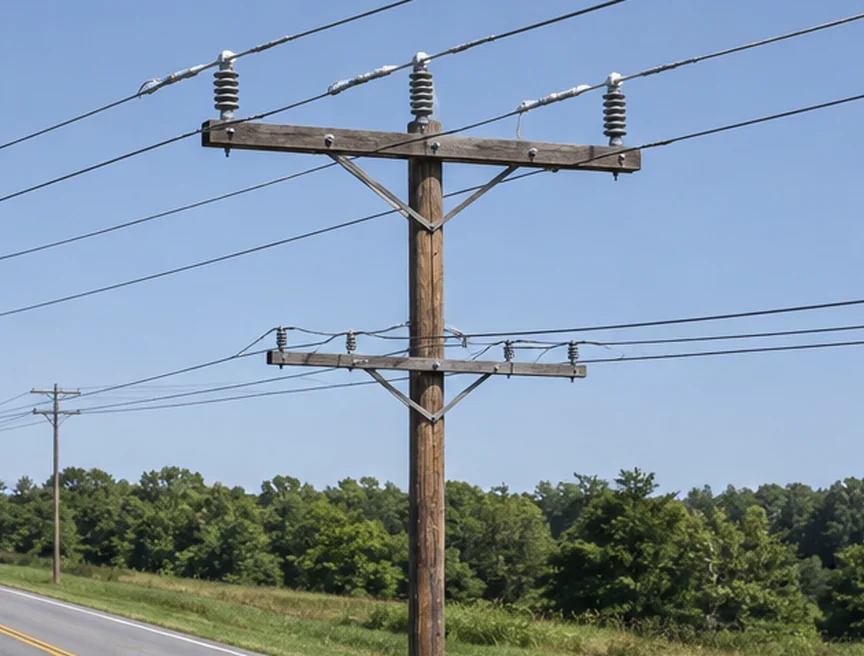
Sometimes the wires high on a pole are carrying power across town, while another set lower down serves that neighborhood. They share the pole, but they can be separate circuits at different voltages. The top set may feed substations. The lower one may feed transformers along the street.
Why share the poles?
It can make room for both circuits along a road that already has power lines. The pole and its crossarms have to be designed for the extra weight and pull. The circuits also need enough space between them, both when the wires are still and when the wind pushes them around.
Are all the lower wires power lines?
Some poles also carry phone, cable, or fiber lines. Those usually occupy a separate space farther down the pole. The height gives you a clue, but it doesn’t tell you exactly which utility owns each wire.
For more on how transmission and distribution fit together, see Basics of Electric Utilities 101.