
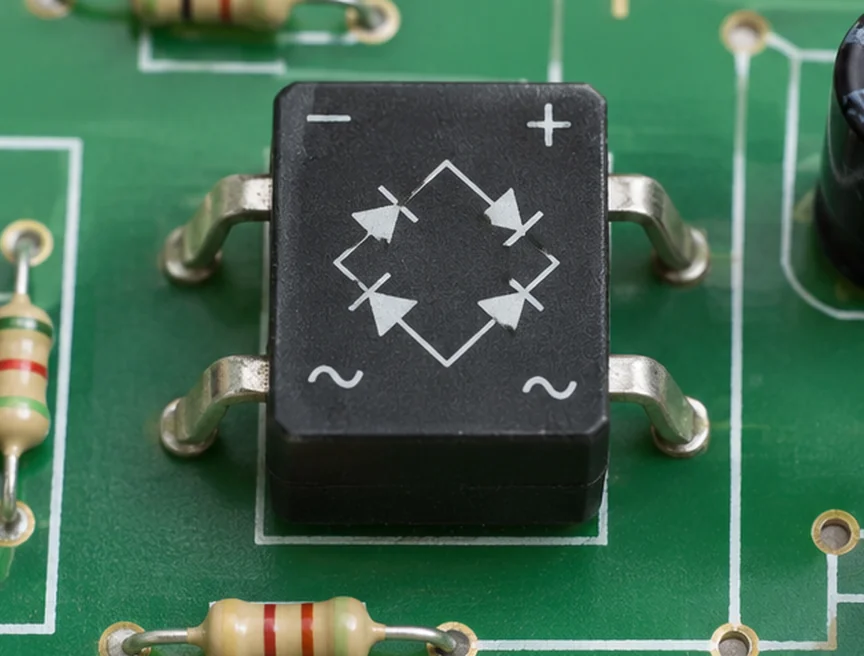
A diode makes it easy for current to go one way and hard for it to go the other. A bridge rectifier arranges four diodes so there are two different paths through it. One pair conducts on one half of the AC cycle. The other pair conducts on the next half.
Why doesn’t the load see the direction reverse?
Both paths enter the load at the same output terminal and leave it at the other. The source changes which pair is conducting. The load sees current in the same direction either way.
Is the result smooth DC right away?
The output still rises and falls as the AC input changes. A power supply can add a capacitor to hold up the voltage between peaks and use a regulator if its load needs a steadier output.
For more on the difference between alternating and direct current, see Basics of Electric Utilities 101.