
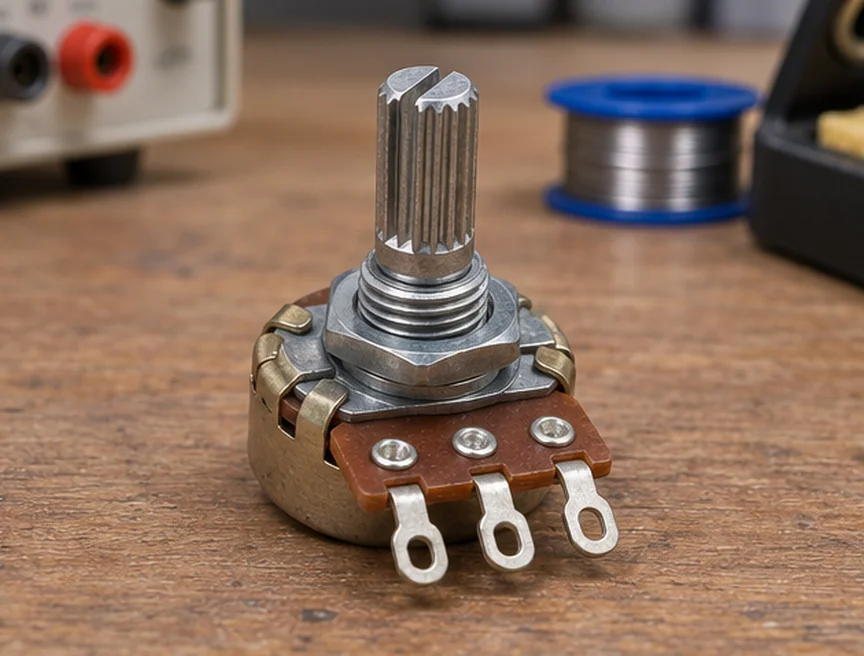
A traditional volume knob can turn a potentiometer. Two of its terminals connect to the ends of a resistive track. The third connects to a moving contact that slides along the track. The position of that contact determines how much of the input signal appears at the output.
Why does turning it down make the music quieter?
At one end of the track the contact can pick up nearly the whole signal. At the other it can pick up very little. The amplifier then gets a smaller signal, so the speaker plays more quietly.
Are all volume knobs wired that way?
Some modern knobs are encoders. They send pulses that tell a computer which way the knob moved. The computer adjusts the volume electronically. The front of the knob can look much the same either way.
For more on voltage and resistance in electrical circuits, see Basics of Electric Utilities 101.