
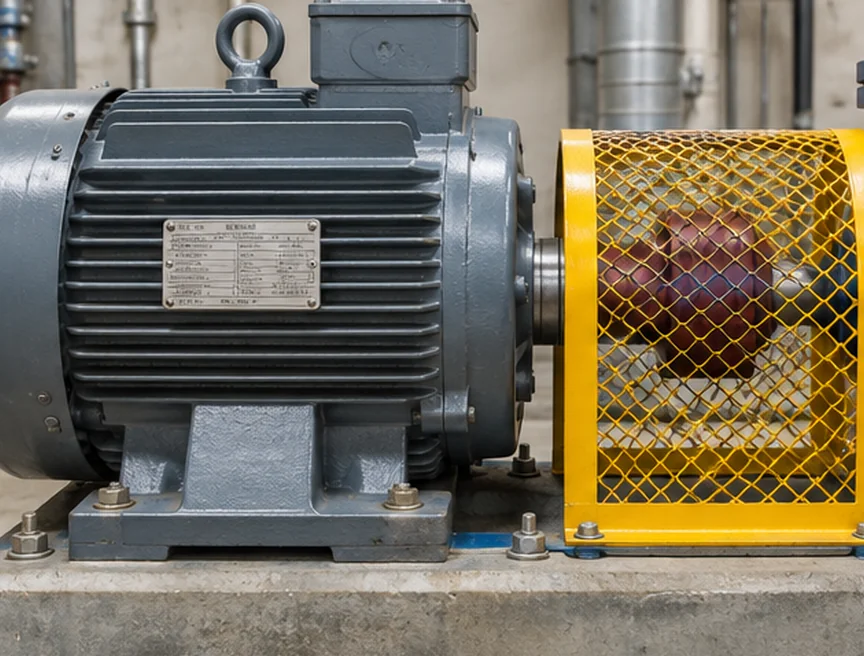
The supply makes a magnetic field that turns inside an induction motor. That field has to move relative to the rotor to produce current in it. The rotor can follow just behind the field. The small difference in speed is called slip.
What if the rotor caught up with the field?
If they turned at exactly the same speed in a normal motor, the rotor would see very little change from the field. It would lose the induced current that gives it turning force. A little difference lets that interaction continue.
Why does the nameplate show a speed like 1,750 rpm?
A common four-pole motor on a 60-hertz supply has a field speed of 1,800 rpm. The nameplate can give the slower speed expected when the motor carries its rated load. The exact speed can change as the load changes.
For more on how alternating current makes a motor turn, see Basics of Electric Utilities 101.