
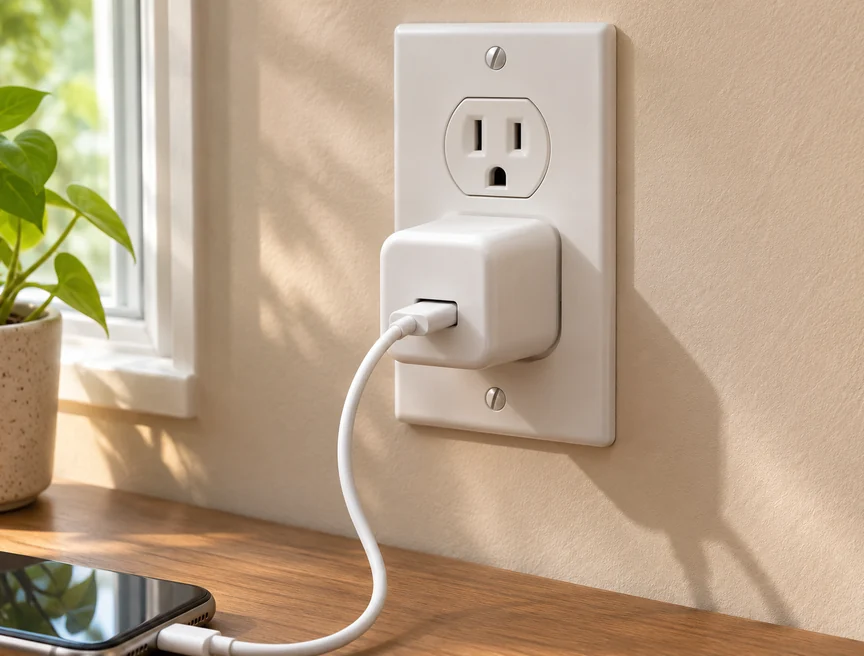
A little of the electricity your charger takes from the wall winds up as heat inside the charger. It’s doing real work in a pretty small box. If you’ve ever wondered why we call it a power brick, apparently it can double as a warm brick.
What is it actually doing?
A typical U.S. outlet supplies 120-volt alternating current (AC). Your phone needs much lower-voltage direct current (DC). The charger does the conversion. Its coils, wires, and electronic switches all have small losses, so a bit of the power coming in heats up the charger on the way through.
Digging deeper
Suppose a charger pulls 20 watts from the wall and sends 18 watts out to the phone. That’s 90% efficiency, with 2 watts left over to warm a box about the size of a couple of ice cubes. Small losses are easy to feel when they’re all in one little package.
The warmth can change as the phone charges. When a phone asks for more power, the adapter can have more heat to get rid of. When it slows down near full, the adapter may cool off.
For more on watts, AC, and DC, see Basics of Electric Utilities 101.