
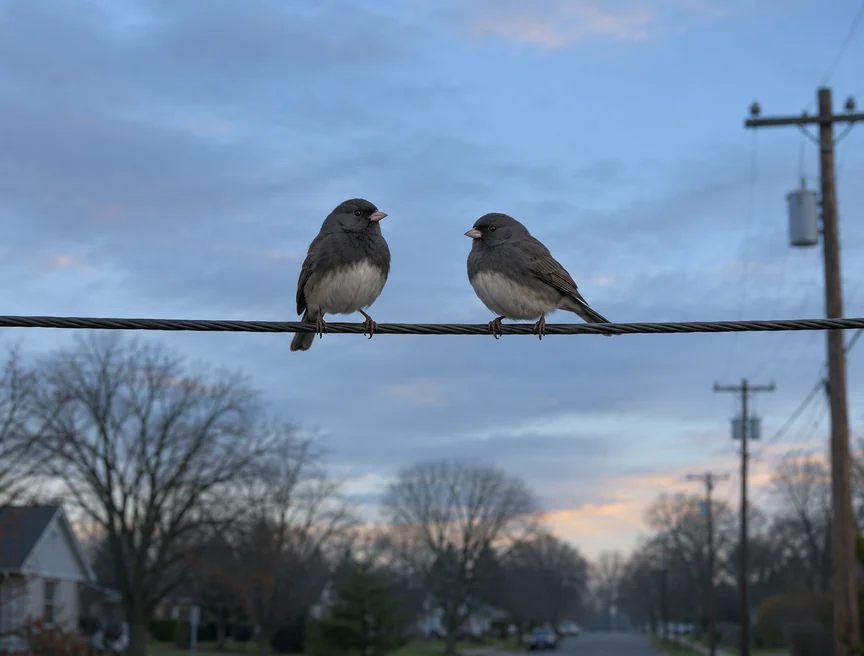
Both feet are on the same wire. That puts them at nearly the same voltage, so there’s very little push to send current up one leg and down the other. The wire can be thousands of volts above the ground while the voltage from toe to toe is tiny. The bird is having a perfectly ordinary Tuesday.
Digging deeper
Think of two taps close together on the same water pipe. Connect them with a short hose and there’s very little pressure difference to push water through it. Now connect one end of the hose to a much lower-pressure pipe and you’ve got a reason for water to move. Voltage works like that pressure difference.
The trouble starts when a bird touches something at a different voltage. A big bird spreading its wings near a pole can bridge two wires, or a wire and grounded hardware. Now there’s a path through the bird and enough voltage difference to drive a dangerous current.
Fun bird fact
Wing size matters to the people who design power poles. Utility crews can put more space between energized parts or cover hardware where a large bird might land. Think of it as planning for the customer with the biggest wingspan.
For more on voltage and current in overhead power lines, see Basics of Electric Utilities 101.