
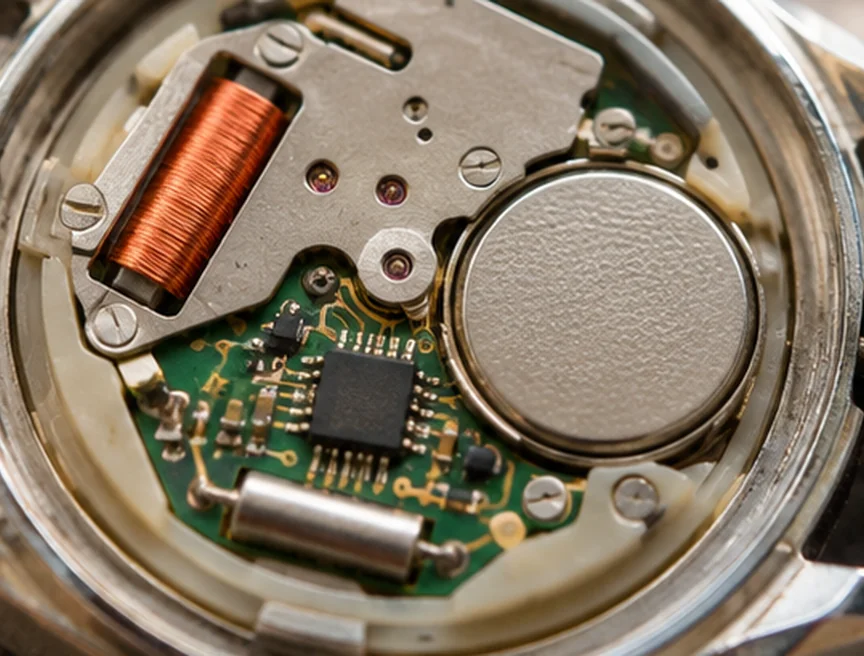
A quartz crystal can flex a little when voltage is applied to it. Bend the crystal and it can also produce a tiny electrical signal. A watch uses those effects together. Its circuit keeps a small piece of quartz vibrating at a very regular rate.
How does that become one tick per second?
A common watch crystal vibrates 32,768 times a second. That number can be divided by two repeatedly until it becomes one pulse per second. A watch can use the pulse to move the second hand or add another second to a display.
Why does the battery last so long?
The crystal and the circuit that counts its vibrations need very little power. A watch with hands also needs a small pulse to move them. Both jobs can run on a tiny battery.
For more on frequency and electrical signals, see Basics of Electric Utilities 101.