
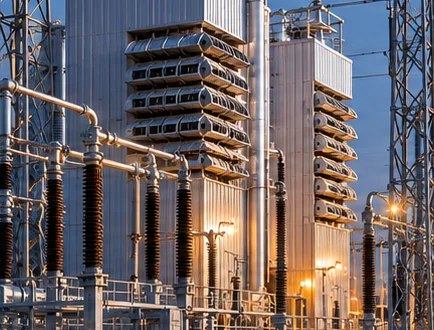
Thomas Edison and his DC (Direct Current) powered grid completely lost out to Nikola Tesla’s AC (Alternating Current) power… or did it? AC won out in large part because transformers made it practical to deliver power at high voltage and step it down at the other end. But new solid-state technology that Edison never had can make DC a better choice for long-distance or underwater high-voltage transmission. Grid planners are taking another look at HVDC (High Voltage Direct Current) lines as we push for greater energy efficiency, join energy markets like EIM, include more renewables and have advances in technology. Is Edison getting his revenge? *evil laugh*
Breaking it down
The cost of transmission in either system depends on 4 main factors. Who is the winner, AC or DC?
1. Cost of transformers
AC’s main advantage is its ability to change its voltage with the use of relatively inexpensive transformers. An HVDC link between AC grids needs converter stations. Modern systems use solid-state semiconductor technologies that Edison didn’t have available.
2. Cost of cable and towers
A bipolar DC line uses two conductors. A three-phase AC circuit uses three. Tower size, clearance, and how much power either can carry depend on the design.
3. Cost of land
An HVDC line can use a narrower right of way than an AC line of comparable capacity.
4. Cost of line losses
DC has no steady-state skin effect or AC cable charging current. A project’s total losses also include losses at the converter stations.
Summary
There can be a break-even distance where DC is the better choice. It varies by project.
Facts
- The first commercial HVDC link was in Sweden in 1954.
- DC converter links can tie together grids that aren’t synchronized, such as the Eastern and Western interconnections.
- DC is particularly suited to long undersea links where AC cable charging current limits usable capacity.
- The Pacific DC Intertie expansion brought that link to 3,100 MW in 1989.
- Japan has two different frequencies and uses DC Converters between them.
Bonus
Solar panels produce DC. Some variable-speed wind turbines produce AC, convert it to DC, then back to AC for the grid. Down the line, a data center may convert AC to DC for its batteries, back to AC for distribution, then back to DC at each server. That’s AC to DC to AC to DC to AC to DC … I can’t make this stuff up! Each conversion can lose some energy as heat.
Explore how HVDC converter stations control power transfers in Electric Transmission Systems training.