
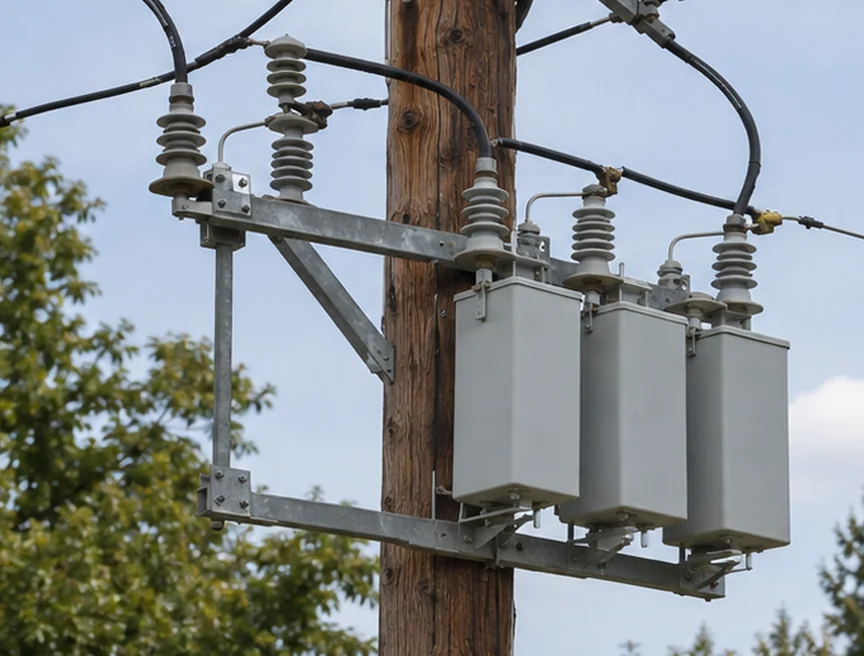
Some of the boxes you see on utility poles form a capacitor bank. Utilities use them to support voltage on a distribution line, especially where equipment like motors and transformers needs help from the grid to maintain its magnetic fields.
What does a capacitor have to do with a motor?
In an AC circuit, motors and transformers store energy in magnetic fields and give some of it back each cycle. Capacitors do a similar kind of back-and-forth with electric fields, with timing that can offset part of what those loads draw from the line. Utilities call that exchange reactive power.
Why put it out on the line?
Putting a capacitor bank near the loads can reduce the current that has to travel from farther away. That can help reduce losses and hold the voltage closer to where the utility wants it. Some banks switch on and off as conditions change. That way they can help when they’re needed.
For more on voltage control equipment along distribution feeders, see Electric Distribution Systems Training.