
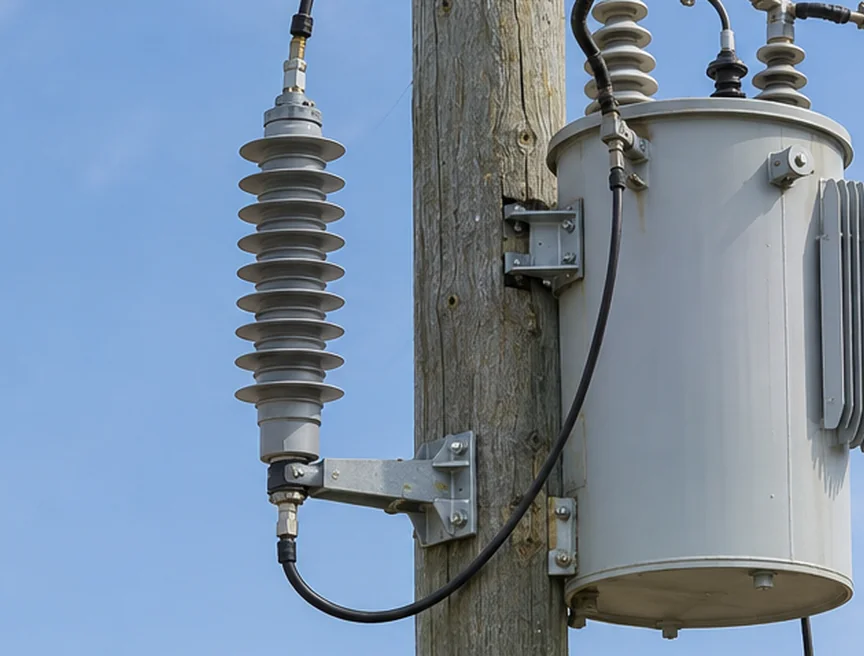
An arrester near a transformer can help protect it from a short jump in voltage. One end of the arrester connects to the line. The other connects to ground. During normal operation, very little current goes through it.
What changes during a surge?
The material inside a common arrester conducts much more when the voltage across it rises sharply. It sends part of the surge current toward ground and limits the voltage across the equipment. When the surge passes, it goes back to carrying very little current.
Why is it mounted so close to the transformer?
A lightning surge changes so quickly that even the wires connecting the arrester can have a noticeable voltage across them. Short connections help keep the voltage at the transformer down. The strike itself can be farther away and send a surge along the line.
For more on equipment that protects overhead distribution lines, see Electric Distribution Systems.