
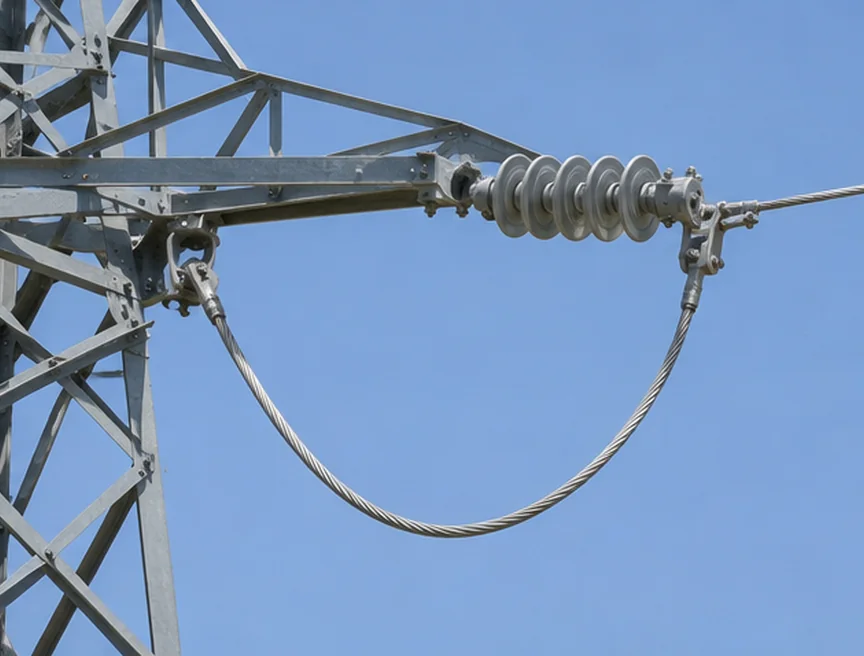
On some towers, a conductor coming from one side is clamped and held under tension before it reaches the next span. Another conductor is held the same way on the other side. The loose loop you see between them is a jumper. It gives the current a path from one side to the other.
Why not pull the loop tight too?
The clamps and insulators handle the pull from the long spans. The jumper mainly needs to carry current. Leaving some slack gives it room to reach around the hardware while keeping it clear of the tower and other phases.
Where would you see one?
They’re common on towers where the line turns or where a section of line is anchored. A tower in the middle of a straight run can simply hold up a conductor that passes through. There’s no need for a jumper at every tower.
For more on how overhead transmission lines are attached and connected, see Electric Transmission Systems.